Foundation
Birth, Failure, Restart: From 2019 to 2023
Follow the official About history section to understand in chronological order the 2019 hard fork, initial halt, 2022 mining restart, and 2023 BTCMobick naming.
The early narrative of BTCMobick is not a simple success story. The official About explains that it was created by a hard fork from the Bitcoin ledger in 2019, but the project did not continue at that time.

Then mining restarted in 2022, and the name BTCMobick was given in 2023. Understanding this flow helps explain why the current community and official roadmap use the language of a 'restarted project'.
Plain words
First-time terms
- Restart
- The event of a previously stopped flow beginning to move again.
- Naming
- The act of giving a project a name to clarify its identity.
- Hard Fork
- The event of splitting into a different rule path from a single ledger base.
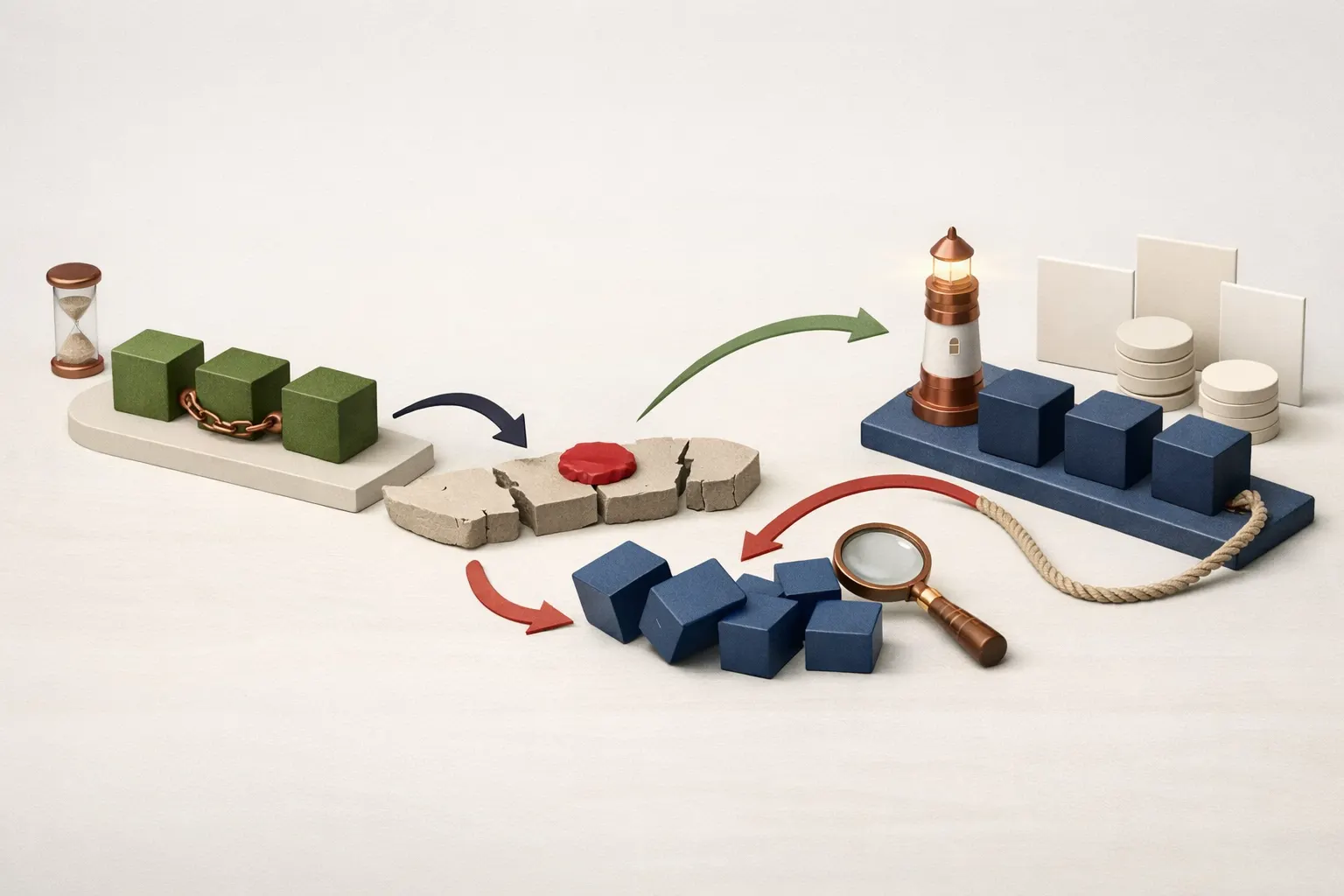
Learning objectives
- Explain the 2019 hard fork and 2022 restart as a single flow.
- Distinguish the timing of the project naming and the ledger reference point.
- Read the official history together with on-chain verification data.
Starting Point in 2019
Official materials describe January 3, 2019, as the hard fork starting point of BTCMobick. On-chain verification uses the relationship between blocks 556759 and 556760 as the basis for reading this starting point.
An important habit here is to mention both 'when it started' and 'which ledger it is confirmed from' together.
2022 Restart and 2023 Naming
The official About records the mining restart on July 16, 2022, and the BTCMobick naming on April 27, 2023.
From this period, BTCMobick is read not just as a fork-side record but as a project where the community named it and began moving again.
Verifying the Gaps Between Birth and Restart
The 2019 birth, initial failure, 2022 mining restart, and 2023 naming are distinct events. The deep curriculum does not compress these into a single success story but shows even the gaps.
Additional data to collect includes the 2019 fork ledger, official or broadcast materials explaining the 2022 restart, and community records around the 2023 naming. Events with dates separate source dates from actual ledger times for storage.
Verification questions start by separating 'the project existed' from 'the network continued operating.' This distinction clarifies the meaning of failure and restart.
History Includes Even the Interrupted Time
Between the 2019 hard fork and the 2022 mining restart, the project did not continue immediately. Omitting this period makes it hard to understand why BTCMobick emphasizes restart and naming today.
For beginners, it is better to show start, halt, restart, and naming as a timeline in four steps. Revealing even the gaps makes the narrative closer to educational material than promotional text.

Memory Points
Points to remember
Reading the 2019 Starting Point in Three Stages
January 3, 2019, is the starting point in BTCMobick’s birth narrative, but it does not mean the project immediately continued in its current form.
The official About records that the initial project did not continue and mining restarted in 2022 with subscriber support. Including this break and restart makes the narrative look like real history.
Viewing the flow in three stages—2019 fork, 2022 restart, 2023 naming—makes the overall flow clear.
Not Equating Birth and Restart
The 2019 start is the first scene in BTCMobick’s narrative. However, reading the current community and ledger flow as uninterrupted from then flattens the history.
The official history treats the 2022 mining restart and 2023 BTCMobick naming as separate events. This distinction keeps the meaning of failure and restart alive.
The project’s strength is better shown in the structure of stopping and then moving again than in saying it was complete from the start.
Why Reading Chronologically Makes Understanding Easier
Fork, halt, restart, naming, Consol, upgrade are different events. Putting these all in one paragraph causes beginners to miss what is current fact.
A timeline firmly fixes the order of events. Attaching sources and ledger evidence next to each event makes the narrative verifiable learning material.
This lesson makes BTCMobick read not as a heroic tale but as a ledger project that went through multiple transitions.
Practice
Organize the Three Dates on Cards
- Write January 3, 2019; July 16, 2022; and April 27, 2023 each on separate cards.
- Label each card as hard fork, mining restart, and BTCMobick naming respectively.
- Link the 2019 card to the ledger data of blocks 556759/556760 in the source library.
Learners can explain BTCMobick’s early narrative as a restarted flow rather than a single date.
Compress into a Four-Box Timeline
- Write the 2019 hard fork, initial halt, 2022 restart, and 2023 naming in four boxes.
- Mark each box whether it is official history or requires ledger verification.
- Write why calling BTCMobick a 'complete project from the start' is inaccurate.
Learners explain BTCMobick’s early history as a flow with interruption and restart rather than a success story.
Key takeaways
- BTCMobick must be understood with both the 2019 starting point and 2022 restart together.
- The project name and ledger reference point are not the same thing.
- The early narrative is stronger when official history and on-chain evidence are viewed together.
- BTCMobick’s early history includes not only birth but also halt and restart.
Quiz
Quiz
What should be checked first in birth, failure, and restart?
What attitude should be avoided when explaining birth, failure, and restart?
Why is birth, failure, and restart important for newcomers?
Evidence and statusSources connected
This localized lesson keeps the same source IDs as the Korean curriculum. Use the source library for ledger checks and official references.
- claim-official-history-2019-2026
- claim-fork-height-sensitive
- claim-mobick-origin-fork